Empty Legs and Hidden Anchorages: How Africa’s Wealthy Are Actually Flying and Sailing in 2026
Travel · Market Report
Empty Legs and Hidden Anchorages: How Africa’s Wealthy Are Actually Flying and Sailing in 2026
Behind the safari lodges and boat-show glamour, Africa’s ultra-luxury travel market is being quietly rebuilt around two unglamorous forces: repositioning flights and privacy.
Suggested alt text: “Private charter jet prepares for departure from Nairobi’s Wilson Airport, 2026.”]
Africa’s private aviation market is no longer a story about a handful of heads of state and mining magnates. It is now one of the fastest-growing charter markets in the world — and the growth is coming, in part, from flights that were never meant to be sold at all.
The Middle East and Africa private jet charter services market is projected to grow from roughly $566 million in 2024 to $943 million by 2029, a compound annual growth rate of nearly 11 percent, driven by a rising base of high-net-worth individuals, expanding corporate travel, and the continent’s deepening role as a global economic hub. Middle East–Africa charter traffic alone climbed an estimated 30 percent in 2025.
But the more interesting shift is not at the top of the market. It’s in what the industry calls “empty legs” — the repositioning flights an aircraft has to fly anyway, returning to base after a drop-off or moving into place for its next booking. Operators increasingly sell these routes at a fraction of standard charter rates, and in 2026 they have become the entry point through which a much wider tier of African travelers is accessing private aviation for the first time.
What an empty leg actually costs
The economics are the story. A standard one-way Cape Town–Johannesburg charter on a Phenom 300 runs roughly $22,000; sold as an empty leg, the same route has gone for around $5,500. A Nairobi–Maun repositioning flight into Botswana’s Okavango Delta — a route that would normally cost close to $25,700 on a Citation CJ4 — has been offered nearer $9,000. Even heavier aircraft see the discount: a Lagos–Johannesburg leg on a Challenger 300, ordinarily around $85,000, has been priced closer to $36,000.
| Route | Aircraft | Standard rate | Empty-leg rate | Savings |
|---|---|---|---|---|
| Cape Town → Johannesburg | Phenom 300 | $22,000 | $5,500 | 75% |
| Nairobi → Maun (Botswana) | Citation CJ4 | $25,700 | $9,000 | 65% |
| Lagos → Johannesburg | Challenger 300 | $85,000 | $36,000 | 57% |
Indicative pricing reported by African charter brokers; final rates vary by seasonality, positioning, and fuel cost.
The catch is timing, not money. Empty legs exist because an aircraft must move regardless of whether a paying passenger is aboard, which means routes and departure windows are dictated by the previous booking, not the buyer. Brokers report last-minute availability inside 24 to 48 hours, but for the December–February and July–August peak seasons — when standard charter rates already climb 20 to 40 percent — travelers are advised to book four to six weeks out if they want a specific window.
For safari-bound travelers, this has quietly changed the calculus around remote-airstrip access to the Serengeti, the Maasai Mara, the Okavango Delta, and Victoria Falls — destinations that have historically priced out all but the wealthiest fliers. Multi-leg itineraries stitched together across several empty-leg segments are now a recognized way to reach two or three of these destinations in a single trip at a materially lower cost than booking each leg new.
The aircraft themselves are getting bigger
Even as the entry point drops, the top of the market is moving toward heavier, longer-range aircraft. Heavy jets — the Dassault Falcon 2000s and Bombardier Global 6000s of the fleet, seating ten or more passengers over 6,000 nautical miles — now account for roughly two-thirds of new charter fleet investment globally, as operators respond to demand for non-stop routes connecting Johannesburg, Nairobi, and Lagos directly to Europe and Asia without a refuelling stop. A heavy jet now covers the Africa–Europe run in eight to ten hours, direct.
That build-out is arriving alongside a broader hospitality shift. Hotel groups including Fairmont, One&Only and Royal Mansour are positioning themselves explicitly around private arrivals — chauffeured transfers, helicopter connections to private islands, or a yacht waiting at the dock — treating the journey from runway to room as part of the product, not a logistics afterthought.
At sea, the same instinct: fewer people, harder to find
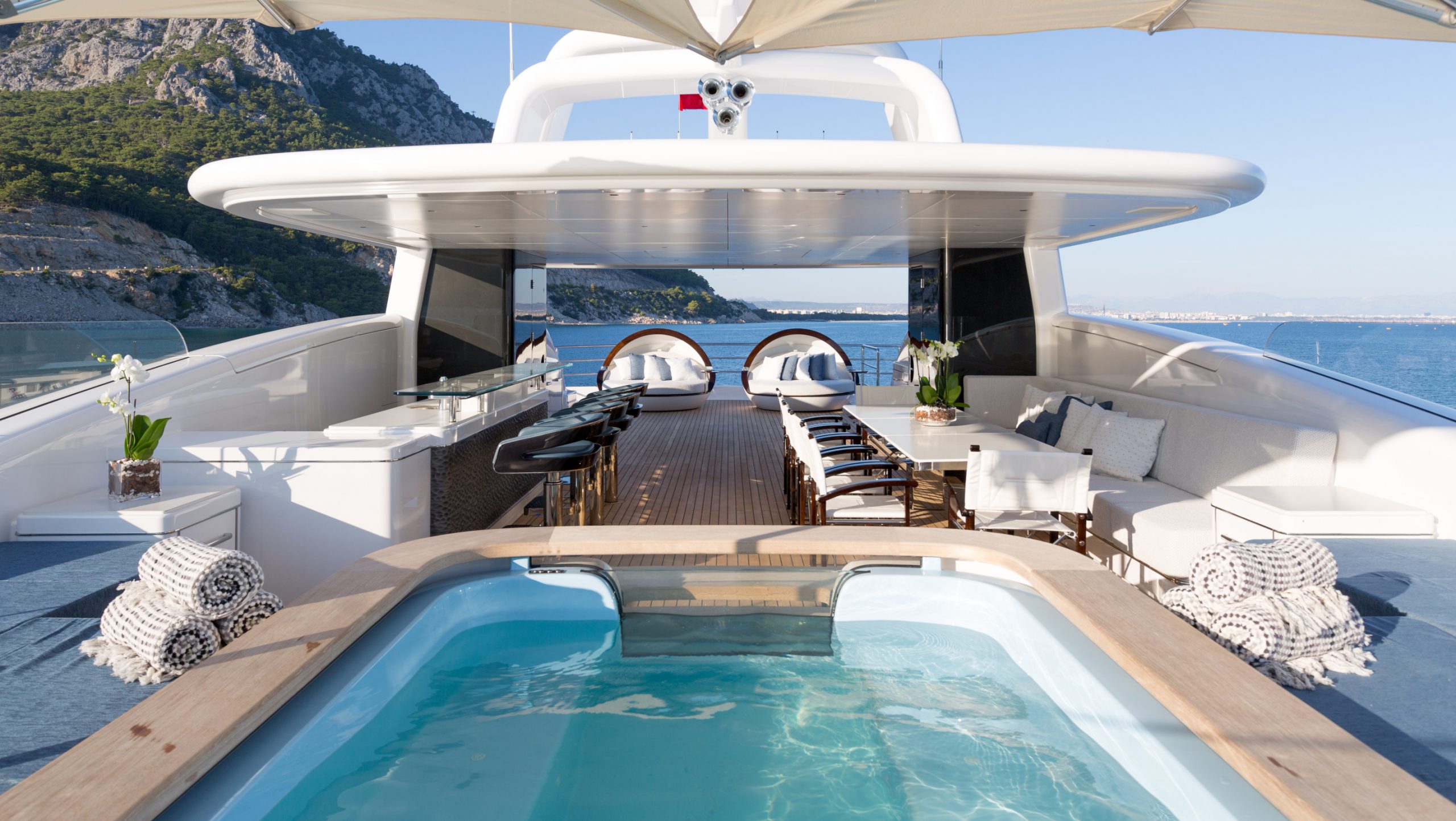
Africa has not historically been considered a major yachting ground the way the Mediterranean or the Caribbean are, but interest in the continent’s coastline has grown steadily over recent years — the Seychelles and Mauritius for turquoise-water cruising, South Africa’s Cape Town-to-Durban run for a more varied coastal itinerary, and Madagascar and Mozambique for the kind of remote, uncrowded anchorages that have become the point of the exercise rather than a bonus.
That instinct lines up with where the wider luxury travel industry is headed in 2026. Global research firms Skift and Virtuoso have both framed this year’s defining shift as “less abundance, more restraint” — privacy and unmarked luxury outranking overt display among the ultra-wealthy. Major hospitality groups are backing that read with capital: Four Seasons, Ritz-Carlton, Aman, Jumeirah and Waldorf Astoria are each building or launching branded yachts, betting that guests will pay a premium for the same discretion at sea that they already expect on land. LVMH chairman Bernard Arnault has taken the logic further, partnering with hotel group Accor to extend the revived Orient Express brand from trains into hotels and yachts.
None of this is Africa-specific — the branded-yacht trend is a global one — but it sets the price anchor against which African charters are increasingly measured. A traditional superyacht charter can run £285,000 a day; the newer, smaller branded vessels are being pitched from roughly £40,000 a week, a gap that has made shared or smaller-group charters along Africa’s own coastline look considerably more reasonable by comparison.
What it means for East Africa
For Kenya, Uganda, Rwanda and their neighbors, the practical effect of both trends is the same: private travel is becoming less about owning the loudest asset and more about controlling access — to a runway slot, to an anchorage, to a room nobody else knows you’re in. Nairobi’s position as a regional aviation hub, already handling charter traffic bound for the Maasai Mara and onward into Tanzania, Botswana and South Africa, puts it structurally well placed to capture more of this shift, provided pricing transparency around empty-leg availability continues to improve.
The wealth funding all of this hasn’t gone anywhere quieter, in other words — it has just gotten harder to see.
View Luxe Properties
Sources
- Safe Fly Aviation, “Private Jet Charter Prices in Africa 2025–2026: Complete Cost Guide,” 2026.
- Safe Fly Aviation, “The Growing Private Jet Charter Market in Africa: Heavy Jets to Europe and Asia in 2025–2026,” 2025.
- Private Jets Connect, “Private Jet Charter Africa | VIP Flight Booking,” 2026.
- YATCO, “Yacht Charter Africa 2025–2026,” 2024.
- Vital Charters, “2026 Travel Trends Defining Modern Vacations,” 2026, citing Virtuoso 2026 Luxe Report and Skift 2026 Megatrends.
- Spear’s Magazine, “Why Luxury Hotels Are Betting Billions on Branded Yachts,” 2026.
- TCS World Travel, “Safari and Adventure: Luxury Private Jet Journey through Africa,” 2026.