The Grand Table Returns: Statement Dinnerware as the New Legacy Asset
Decor & Dinnerware · Market Report
The Grand Table Returns: Statement Dinnerware as the New Legacy Asset
As East Africa’s newly built luxury homes move toward furnished, design-led interiors, what goes on the table is starting to matter as much as what’s built around it.
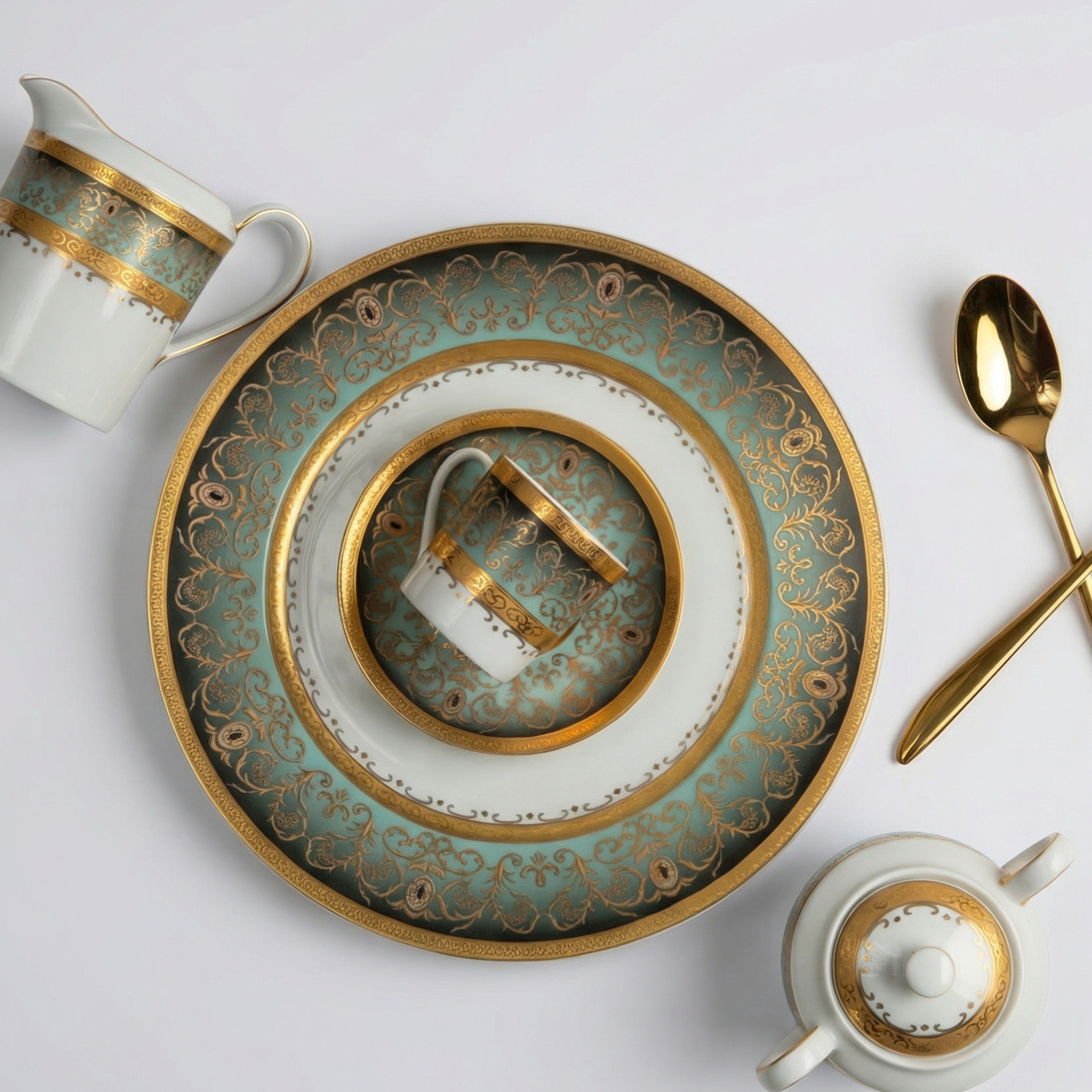
Suggested alt text: “Statement dinnerware place setting featuring hand-finished porcelain and brushed gold flatware, 2026.”]
The clearest evidence that dinnerware has become a serious collecting category didn’t come from a design fair. It came from an auction house. When Sotheby’s sold the personal collection of the late interior designer Mario Buatta, buyers cleared 99 percent of nearly a thousand lots — English and Chinese export porcelain, silver, glassware, pottery — for a combined total north of $7.6 million. The lesson the market took from it has only gotten louder since: a dinner table, assembled with the right pieces, is no longer just a setting. It’s a portfolio.
That logic is now filtering into how East Africa’s newest luxury homes are being furnished. As villas in Lavington, Karen, and Kigali’s Jasmine Hills move toward fully furnished, design-led interiors rather than empty shells handed to a decorator later, the objects placed on the table are being chosen with the same permanence as the architecture around them.
Quiet over loud, but not simple
The aesthetic driving this shift is what design houses are calling “conscious glamour” or “quiet luxury” tableware — a move away from bright, obvious opulence toward subtler metallics in bronze, copper, and brushed gold, paired with textures like fluted glass and finely worked ceramic detail rather than loud pattern or shine. Cutlery has followed the same path: bright yellow gold finishes are giving way to desaturated champagne gold and brushed bronze, softer metals that read as considered rather than showy.
Color has moved the same direction. Stark white is being replaced by warmer, stonier neutrals, while a small set of deeper, moodier tones — muted greens, ochre, ink-adjacent teals — are being used for what stylists call “color drenching,” where tablecloth, placemats, and plates share a single deep tone rather than contrasting against a white base. Vanessa Carter, marketing manager at UK tableware house Artis, has pointed to muted green and warm cream palettes as a defining combination for the year, arguing the tactile qualities of a piece now matter as much as its color story.
The imperfection is the point
The other defining shift is a deliberate move away from factory-perfect uniformity. Reactive glazes — which shift color unpredictably during firing, producing speckling and drips that make no two pieces identical — are now positioned as a selling point rather than a flaw, alongside slightly irregular, hand-thrown-looking forms sometimes described as the “wabi-sabi” influence. Buying a full boxed set is increasingly seen as dated; the current approach is “open stock” collecting, building a table from individual pieces — a matte stoneware bowl here, a hand-painted charger there — the same way a serious collector builds an art wall.
That shift matters for how value gets built over time. Limited-edition collaborations between working ceramic artists and established lifestyle houses are increasingly treated as somewhere between tableware and art, appealing to buyers who want a piece that can be used at dinner on Tuesday and appreciated in value by the time it’s inherited.
Why this belongs in the same conversation as real estate
The connecting thread between the villa and the table is the same one running through Africa’s broader luxury property shift: buyers increasingly want a finished, curated environment rather than a blank canvas they have to fill themselves. A newly built home with the right architecture and the wrong table setting reads as unfinished in exactly the way a statement dining piece reads as complete on its own. Interior decorators serving private residences and hospitality projects across the region are increasingly being briefed on tableware and case pieces at the same stage as flooring and lighting — not as an afterthought once the walls are up.
It also explains why pieces like a malachite and Calacatta marble dining table, or a rock crystal quartz bathtub, are being positioned less as furniture and more as functional sculpture: objects designed to anchor a room the way a painting would, and to be handed down rather than replaced.
What to actually look for
For buyers treating tableware as a legacy purchase rather than a seasonal refresh, three things determine whether a piece holds value the way porcelain and silver historically have: a documented maker’s mark, material quality (fine bone china and sterling silver over mass-produced ceramic or plate), and provenance — a traceable history of ownership that a future buyer, or a future generation, can verify. Auction houses consistently note that a marked, provenanced piece can sell for many multiples of an unmarked equivalent in the same material and period, which is the same logic now being applied to newly commissioned statement pieces: buy from a maker whose name and technique will still mean something in twenty years, not just a pattern that photographs well this one.
View Decor & Interiors
Sources
- Sotheby’s, “Sell Your Porcelain and China with Sotheby’s,” referencing the Mario Buatta: Prince of Interiors sale, 2020.
- Sotheby’s, “Selling Antique Silver with Sotheby’s,” 2026.
- Antique Value Checker, “AI Price Scanner 2026,” on maker’s-mark value premiums.
- The Caterer, “Six Essential Tableware Trends for 2026,” featuring Artis, Nisbets, WMF Professional and Lockhart Contract Catering.
- Hackrea, “Tableware Trends 2026: The Ultimate Guide to Dining in Style,” 2026.
- Joyye, “Tableware Design Trends 2026 to Watch,” 2025.
- Catalonia Plates, “Tableware Design Trends 2026 to Watch Out For,” 2026.